
Google Achieves 40-Fold Error Reduction in Quantum Computing Breakthrough
Google Quantum AI has published research in Science showing that magic state cultivation on its Willow processor reduces errors about 40-fold, achieving a record 99.99% fidelity.
CryptoMEV Bot Newsroom4 min read
Key takeaways
- Magic state cultivation achieved 40-fold error reduction on Google's Willow processor, reaching 99.99% fidelity
- Producing magic states previously consumed up to 95% of a quantum computer's capacity
- Breaking RSA-2048 would require errors near one in 10 billion—about one million times cleaner than current results
- First demonstration of magic state cultivation working on actual quantum hardware rather than in theory or simulations
- Breaking Bitcoin's elliptic curve cryptography could require fewer than 500,000 physical qubits, though this remains far from practical
What Happened
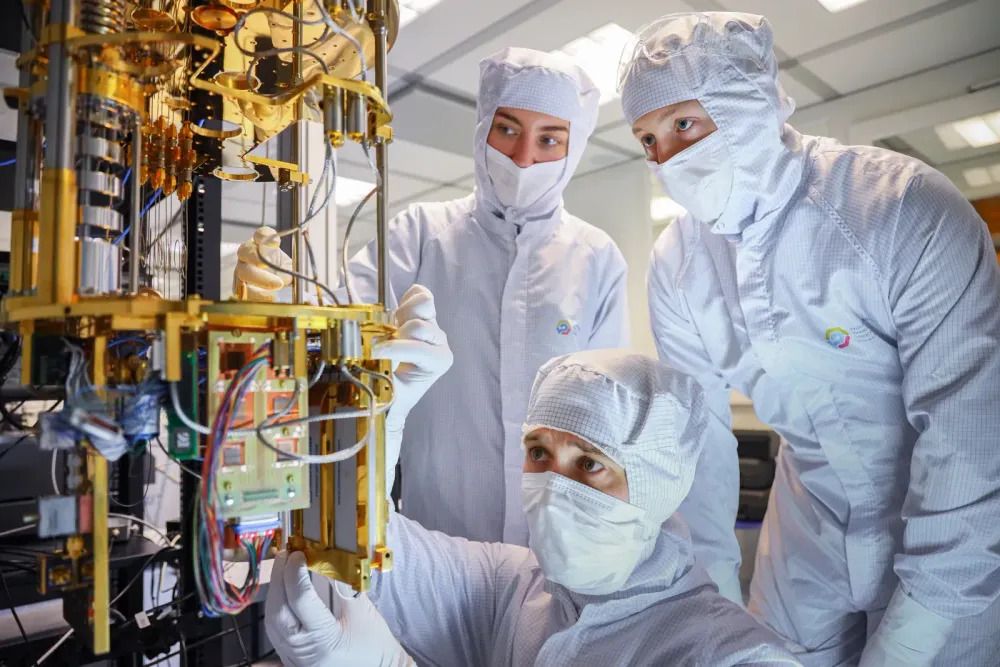
Google Quantum AI released a paper in Science on Thursday showing that magic state cultivation can operate on actual quantum processors. Tests run on Google's Willow chip delivered a 40-times decrease in errors versus states that weren't cultivated, yielding magic states with 99.99% fidelity—a new record. It's the first time this method has been proven to function on real quantum hardware instead of only in theory or computer simulations.
The Magic State Bottleneck
Magic states are one-time-use resources needed to run quantum programs that surpass what ordinary computers can do. These machines rely on qubits—quantum bits that can simultaneously exist in a combination of 0 and 1, allowing them to test many possible answers simultaneously. Yet qubits are extremely delicate: even minor heat or electromagnetic interference can cause a qubit to flip and ruin a computation, which explains why error correction dominates the industry's focus.
Error correction manages straightforward operations effectively, but running genuinely useful programs also requires harder operations that can't be protected the same way. To execute those, the system must first produce magic states, which act like single-use fuel cells—each one gets destroyed the moment it's used.
Generating these states has proved extremely resource-intensive (Decrypt). Google indicates that making magic states may consume as much as 95% of a quantum computer's total resources, leaving almost nothing for actual computation. This obstruction has been understood since 2004, when physicists Sergei Bravyi and Alexei Kitaev suggested magic state distillation as a solution. That approach takes many noisy magic states and distills them into fewer pristine ones, though it needs large qubit "factories" dedicated solely to that purpose.
How Cultivation Works
The method was introduced in 2024 by Google researchers Craig Gidney, Noah Shutty, and Cody Jones. Rather than constructing extensive factories, cultivation acts as a screening mechanism: the processor introduces a rough magic state into a small chip region, then runs coordinated measurements to scan for errors, rejects any attempt showing flaws, and continues growing the ones that pass. Approximately 8% of tries succeeded in passing all checks, meaning more than nine out of every ten attempts get discarded to isolate a single clean state.
The development process involved substantial problem-solving. While initially testing the cultivation protocol, Google Quantum AI research scientist Emma Rosenfeld encountered data that appeared to contradict physical laws. Following months of investigation, simulations, team discussions, and consistency checks, she determined the problem stemmed from an incorrect assumption in the team's standard measurement method. Specifically, noise originating from electrical equipment drift and temperature fluctuations in the laboratory was affecting the benchmark's accuracy. The fix required shifting both their theoretical and engineering strategies. The group added extra controls to the setup to lessen that noise's impact and created a fresh benchmarking method to address the issue more fundamentally—using cultivation itself as the measurement tool.
What This Means for On-Chain Traders
This advancement matters for crypto traders because quantum computers could eventually threaten the encryption safeguarding Bitcoin wallets and blockchain transactions. Google researcher Craig Gidney projected in 2025 that cracking RSA-2048 encryption might need fewer than one million noisy qubits—a reduction by a factor of 20 from his 2019 estimate of 20 million. Breaking Bitcoin's elliptic curve cryptography could require under 500,000 physical qubits.
Yet practical code-breaking is still distant. The recent test used at most 54 of Willow's 105 qubits, and factoring an RSA-2048 key would need magic states with error rates near one in 10 billion—roughly a million times more precise than what Google has just achieved. The team estimates that cutting Willow's underlying hardware noise in half would lower magic state errors to about two in 100,000.
Making quantum computers less expensive to build brings closer the day when they could break encryption protecting bank logins and Bitcoin wallets, although the technology also offers valuable applications like drug discovery and new material design.
Technical Achievements
The group also showed that different quantum error correction schemes can work together, successfully moving between "color codes" and "surface codes" and transferring states between them. This proved for the first time that these theoretical methods function on actual quantum hardware. The research sets a new benchmark in quantum measurement techniques and marks an essential step toward expanding quantum computing to practical applications.
Read more
- AI Crypto Trading Explained: Tools & Strategies for Automated Trading
- Advanced Front-Running Bot for MEV
Sources
- Google Says It Just Cracked One of Quantum Computing's Biggest Bottlenecks — decrypt.co, 2026-10-15
- Breaking a quantum computing bottleneck — ornl.gov, 2026-10-09
- Google breaks open a bottleneck in quantum computing — blog.google, 2026-10-15